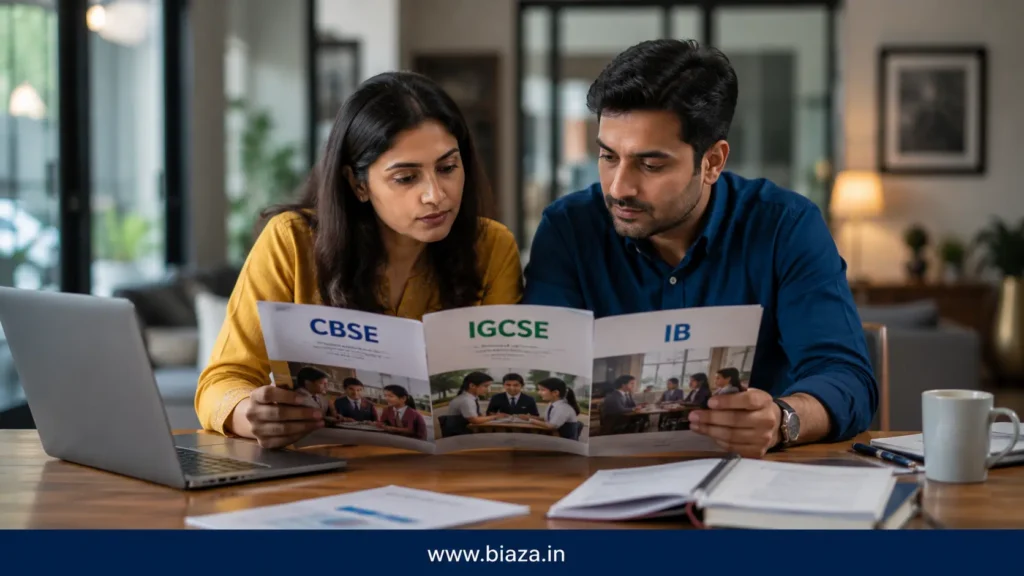
Every parent faces this moment. There are three curriculum options, a pile of school brochures, and no clear idea of which one is right for your child. CBSE vs IGCSE vs IB. Each option sounds impressive and promises great results.
However, they cater to different types of students, goals, and families. This guide provides a straightforward, honest comparison to help you make a decision you feel good about.
Table of Contents
- What Is CBSE?
- What Is IGCSE?
- What Is IB?
- Quick Comparison Table
- How They Approach Learning
- University Admissions and Global Recognition
- Cost Breakdown
- Which One Is Right for Your Child?
- Pros and Cons
- FAQs
- Conclusion
- Talk to a Curriculum Expert at BIAZA
What Is CBSE?
CBSE is India’s national school board. It is managed by the Indian government and is followed by over 26,000 schools worldwide. This curriculum is the most popular and the most affordable in the country. Follows the NCERT syllabus
- Follows the NCERT syllabus
- Strong focus on Maths, Science, and Languages
- Board exams at Grade 10 and Grade 12
- Directly aligned with JEE and NEET preparation
- Best for families who are settled in India long term
What Is IGCSE?
IGCSE is offered by Cambridge Assessment International Education and covers Grades 9 and 10 for students aged 14 to 16. It is one of the most recognized school qualifications in the world.
- Students can choose from over 70 subjects
- Assessment is a mix of written exams and coursework
- Recognized in more than 160 countries
- Great stepping stone to A Levels or IB Diploma
- Best for families who may relocate internationally
What Is IB?
The International Baccalaureate is offered by the IBO in Geneva and is widely considered the most rigorous and globally respected secondary school curriculum available.
- The Diploma Programme (DP) is designed for students aged 16 to 19
- Includes six academic subjects plus Theory of Knowledge, an Extended Essay, and CAS
- Accepted by over 5,000 universities in 160 countries
- Prepares students exceptionally well for top global universities
- Best for self motivated, intellectually curious students with big university ambitions
How They Approach Learning(CBSE vs IGCSE vs IB)
CBSE
- Structured and syllabus driven
- Predictable format that students can prepare for clearly
- Historically more exam focused but improving with NEP 2020 reforms
- Great for students who like clear goals and defined targets
IGCSE
- Focuses on understanding and applying concepts rather than memorizing
- Coursework trains students to manage long term projects
- Subject flexibility keeps students genuinely interested
- Feels closer to university style learning
IB
- The most demanding of the three, by a distance
- Theory of Knowledge pushes students to question everything they know
- The Extended Essay is a 4,000 word independent research paper
- CAS requires students to pursue creative, physical, and community activities
- Builds critical thinking, writing, and research skills that last a lifetime
University Admissions and Global Recognition
CBSE
- Widely recognized across India and South Asia
- For international university admissions, students usually also need SAT, ACT, or IELTS scores
- Very strong for Indian competitive exam routes like JEE and NEET
IGCSE
- Cambridge qualifications carry strong weight in the UK, Australia, Singapore, and Canada
- A solid foundation for A Levels or IB Diploma
- Opens international doors that CBSE alone does not
IB
- The most powerful school qualification for global university admissions
- Actively preferred by many Ivy League, Oxbridge, and top Asian universities
- Some universities grant advanced course credits to IB graduates
- Global pass rate in 2025 was around 80%, with an average score of 30 out of 45
Cost Breakdown
Here is what families in India are typically spending in 2026 for CBSE vs IGCSE vs IB.
- CBSE schools range from nearly free in government schools to around Rs 1.5 lakh per year at top private schools
- IGCSE schools typically cost between Rs 3 lakh and Rs 7 lakh per year
- IB schools run from Rs 5 lakh to Rs 15 lakh and above, plus IB exam fees of up to Rs 1 lakh
- CBSE students aiming for JEE or NEET often spend an additional Rs 1 to 3 lakh on coaching
The right question is not just what you can afford. It is what gives your child the best return for their specific goals.
Which One Is Right for Your Child (CBSE vs IGCSE vs IB)?
Choose CBSE if your child:
- Is aiming for JEE, NEET, or other Indian entrance exams
- Performs well under exam pressure with a clear syllabus to follow
- Will likely study and stay in India for the long term
- Needs an affordable education without compromising on quality
Choose IGCSE if your child:
- May study or live abroad before finishing school
- Learns better through coursework and varied assessments
- Has wide interests across science, arts, and humanities
- Needs a globally recognized Grade 10 qualification
Choose IB if your child:
- Is genuinely curious, loves to read, and writes confidently
- Is aiming for a top ranked university outside India
- Can handle serious academic pressure and manage their time well
- Thrives when given intellectual freedom rather than a fixed syllabus
Pros and Cons

CBSE
- Affordable and accessible across India
- Perfect alignment with JEE and NEET preparation
- Easy school transfers if your family relocates within India
- Can lean toward exam memorization over deeper understanding
- Limited subject flexibility compared to IGCSE or IB
IGCSE
- Globally portable Cambridge qualification
- Balanced assessment style suits a wider range of learners
- Excellent preparation for A Levels or IB Diploma
- Significantly more expensive than CBSE
- Not suited for students planning to attempt JEE or NEET without extra coaching
IB
- Most recognized curriculum for top global university admissions
- Builds real world skills like research, critical thinking, and time management
- Graduates often find university far less intimidating
- Highest cost of the three
- Concentrated mostly in metro cities in India
- Students targeting IITs or AIIMS need significant additional preparation
Frequently Asked Questions
What is the main difference between CBSE and IGCSE?
CBSE follows an Indian curriculum that focuses on national education standards. In contrast, IGCSE offers an internationally recognized curriculum that places a greater emphasis on conceptual learning and global perspectives.
How do the educational philosophies of CBSE and IGCSE differ?
While CBSE focuses on structured syllabus-based learning and exam preparation, IGCSE promotes inquiry, critical thinking, and application-based learning.
Can a student switch from CBSE to IB or IGCSE?
Yes, most commonly at Grade 9 or Grade 11. It takes some adjustment but good schools have support in place for exactly this transition.
Which education board is better for university admissions?
Both boards are widely accepted. CBSE is ideal for Indian universities and competitive exams, while IGCSE is often preferred by students planning to study abroad.
Which curriculum is the hardest?
IB Diploma is the most demanding by far, followed by IGCSE, and then CBSE in terms of day to day academic intensity.
Talk to a Curriculum Expert at BIAZA
Still not sure which path is right? You do not have to figure this out alone.
At BIAZA, our curriculum advisors have real conversations with families every day who are facing exactly this decision. No sales pitch. No pressure. Just honest guidance from people who know these curricula inside and out.

https://shorturl.fm/35Kgm